

Israel and Palestine




12 Significant Times in History leading to the 2023- Present Israel and Palestine Conflict
Israelis and Palestinians around the world have felt the effects of the ongoing battle going on between Israel and Hamas. The events beginning on October 7th shocked the globe, and the conflict continued to grow. Yet this war holds years and years of history.
1917
The Balfour Declaration, issued by the British government as a response to the Zionist movement, states a promise for a "national home for the Jewish people" that would be located in Palestine, which then was ruled by the Ottoman Empire.
End of World War I
The Ottoman Empire conceded, and the land of Palestine was placed under the rule of the British by the League of Nations. Palestinians still lived on the land and were seeking independence.
1920's-1930's
Tens of thousands of Jewsish people began migrating to Palestine due to Britain's promise as well as the Nazi Persecution. Clashes between Palestinian Arabs and Jewish migrants started. The Region begins to witness hundreds of deaths
1947
The United Nations developed a resolution to divide Palestine into two independent states, a "Jewish State" and an "Arab State." Jerusalem would remain under the control of the United Nations due to the city's significance with a number of religious groups. Palestinians refused to recognize the resolution because of their want for independence, and fighting between the two groups raged on.
1948
The Israeli Declaration of Independence declares the establishment of a Jewish State in Eretz-Israel to be now known as the State of Israel. Following this, the Arab League, on behalf of Palestinian Arabs, marched troops into former British Palestine, starting the 1948 Arab-Israeli War. creation-israel
With the help of foreign powers from around the world, Israel won the war, and Palestine was divided. Israel, under the control of the Jewish people; the West Bank and Gaza, under the control of Egypt and Jordan.
June 5th, 1967
The series of back-and-forth military attacks began the Six-Day War when Israel attacked Egypt, Jordan, and Syria. In six days, Israel had captured the West Bank, Gaza, East Jerusalem, and the Sinai Peninsula. The majority of Palestinians in the area became refugees, and Israel's occupation of Palestine began.
1987
Due to Israel's occupation of Palestinian territories in 1987, the Palestinians started an uprising. The First Uprising (The First intifada) was motivated by the frustration of the Palestinians in occupied territories. Civil disobedience and riots were carried out. In response, Israel deployed around 80,000 soldiers. The ongoing battle did not end until 1993.
1993
Yitzhak Rabin and Yasir Arafat sign the Oslo Accords. In the Oslo Accords, both sides agreed that the Palestinian Authority would have governing responsibilities of the West Bank and Gaza for the next five years, and the talks about a permanent status would start. It also recognized Israel's 'right to exist'.
2000
Bill Clinton, Ehub Barak, and Yasser Arafat meet at Camp David for a summit meeting to negotiate the Middle East peace process. The summit ended without an agreement. This is often credited with the start of the Second Intifada. During the Second Intifada, both soldiers and civilians suffered injuries and deaths. The fighting involved shootings, targeting killings, tank attacks, and airstrikes by the Israeli forces, while Palestinians used methods like gunfights, suicide bombings, throwing stones, and launching rockets. The suicide bombing became known because, unlike the First Intifada, this was much more severe in terms of violence and civilian casualties. There is no exact moment that ended the conflict, but most agree it had run its course by 2005 with still no solution. camp-david-summit-2000
2006
In the 2006 Palestinian legislative election, Hamas won the majority of seats in a landslide. Israel, The United States, and The European Union, along with several other European and Western countries, cut off their aid to Palestine.
2007
Israel released $100 million in tax revenues that had been withheld with the intent to cover humanitarian needs and other basic needs. They requested, "Keep the money out of the hands of the Hamas government."
Hamas took over Gaza in a military conflict between Hamas and Fatah, known as the Battle of Gaza.
Students of Israeli and Palestinian backgrounds find themselves each grappling with the emotional toll of a conflict with deep historical roots. This history is important to understand how this conflict has grown to where it is today and why people all around the world have spoken out.
2007-2023
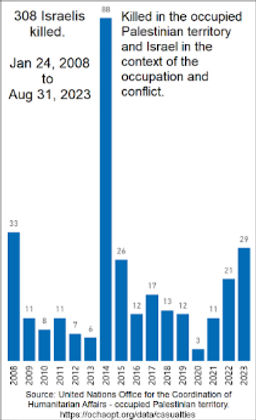
Continued fighting between Israel and Hamas.
October 7th 2023 2023/10/07
The Iran-backed terrorist group Hamas launched a vicious attack on Israel, killing 1,200 people in Israel and taking over 200 hostages.
